Every slushie machine solves the same two problems: get a sweet drink below its freezing point, and stop the ice from fusing into a solid block. Compressor machines, the kind sold as home slushie makers and used in shops, do the first with refrigeration and the second with a turning auger. Cheaper designs swap the compressor for ice and salt or for shaved ice, and a squeeze cup does the whole job by hand.
What are the parts of a slushie machine?
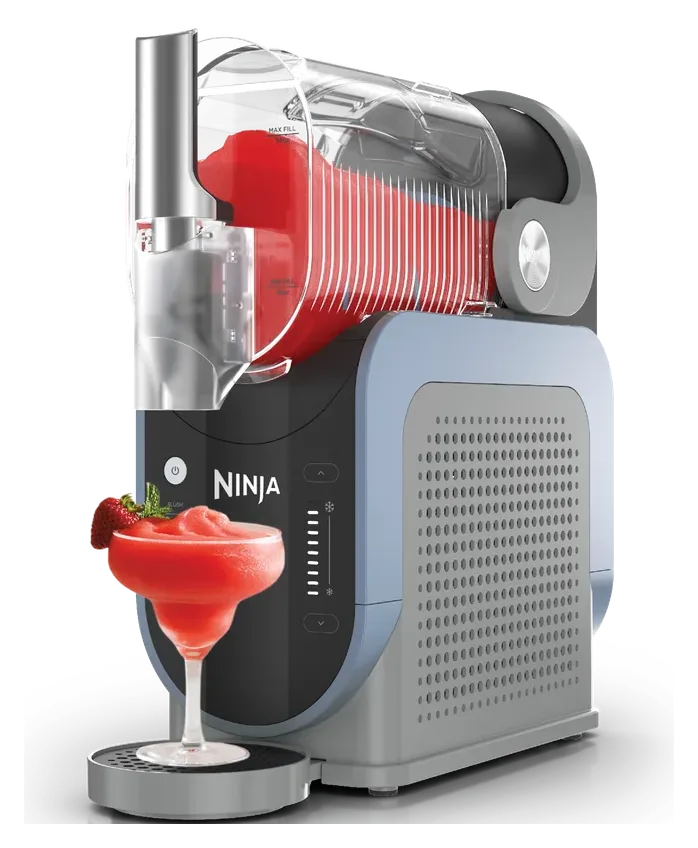
Ninja's owner's guide for the SLUSHi FS301 labels the parts of a typical home compressor machine (Ninja FS301 guide, copy). Commercial bowl machines use the same layout at a larger scale.
| Part | Ninja's name | What it does |
|---|---|---|
| Compressor and refrigerant circuit | Inside the motor base | Pumps refrigerant around a sealed loop to pull heat out of the drink and dump it into the room |
| Chilled cylinder | Evaporator (attached to the motor base) | The metal drum the refrigerant boils inside; it gets well below freezing and the drink freezes on its surface |
| Auger | Auger | A spiral that slides over the evaporator and turns, scraping crystals off the cold surface and circulating the drink |
| Motor | Motor base | Turns the auger; Ninja's machine pauses itself if the auger is overloaded |
| Vessel or bowl | Vessel | Clear container that holds the drink around the evaporator; 16 oz (473 ml) minimum and 64 oz (1.9 L) maximum on the FS301 |
| Fill opening | Easy-fill port and cover | Where liquid goes in without removing the vessel |
| Tap | Pour spout and handle | Pull to dispense; slush is pushed forward by the auger |
| Drip catchers | Condensation catch and drip tray | Collect condensation from the cold evaporator and drips from the spout |
| Controls | Control panel | Programs and temperature levels that set how cold, and so how thick, the slush gets |
| Vents | Rear and sides of the unit | Let the condenser shed heat; Ninja says to keep at least 4 inches clear on both sides and the back |
How does the compressor make the cylinder cold?
The machine is a small refrigerator built around one cold metal surface. It runs the standard vapor-compression cycle (Wikipedia):
- Compressor. Squeezes refrigerant vapor to a high pressure, which also makes it hot.
- Condenser. The hot gas sheds heat to the room through coils and vents and condenses into a liquid. This is why the sides and back of the machine get warm and need clearance.
- Expansion valve. The liquid passes through a restriction and its pressure drops abruptly, so it gets very cold.
- Evaporator. The cold refrigerant boils inside the drum the drink touches, absorbing heat from the drink. The vapor returns to the compressor and the loop repeats.
Two practical consequences follow. Ninja's guide says to let the machine stand upright for at least 2 hours after unboxing, and again after it has been on its side, so the refrigerant oils settle before running. And the guide warns the refrigerant is flammable and the tubing must not be punctured.
Why does the auger matter?
Without the auger, the drink would freeze onto the drum as a hard shell and the rest would stay liquid. The auger does three jobs at once:
- Scrapes. It wipes crystals off the cold surface while they are still tiny.
- Mixes. It carries those crystals into the warmer liquid and brings new liquid to the drum.
- Feeds the tap. Its spiral pushes slush toward the spout so it dispenses evenly.
Wikipedia's slush article describes the same arrangement in commercial machines: the drink freezes on a cylinder and a rotating dasher scrapes it off (Wikipedia, Slush). Constant scraping is why machine slush is finer and more even than anything a fork in a freezer can make.
Why does a slushie machine need sugar?
Sugar lowers the freezing point of water, a property called freezing point depression. Food scientist H. Douglas Goff explains that the effect depends on the number of dissolved molecules (Goff, University of Guelph). As the machine freezes water out of the drink, the liquid left behind gets sweeter and freezes at an even lower temperature, so there is always syrup between the crystals. That syrup is what makes slush pourable.
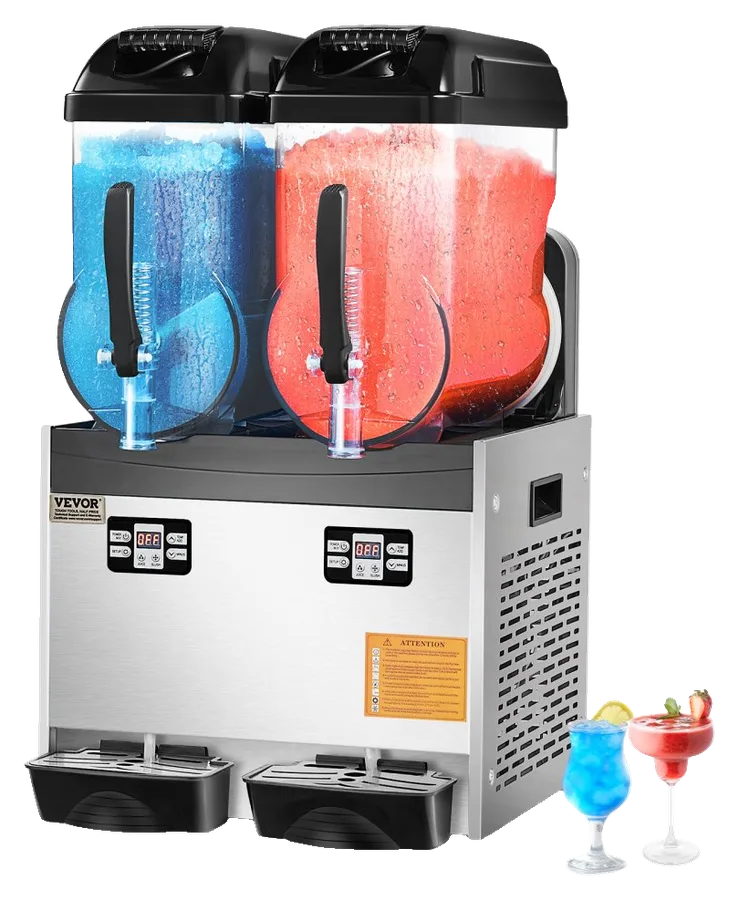
This is why every compressor machine sets a sugar minimum. Ninja's US guide requires at least 4 percent sugar; the VEVOR X-40 listing says 6 percent; the VEVOR commercial two-tank listing recommends about 13 percent (VEVOR XRJ12X2 listing (paid link)). Alcohol lowers the freezing point too, so the same machines cap it. Too much of either and the drink never thickens. Diet drinks are the opposite problem, covered in sugar-free slushies.
How does the machine know?
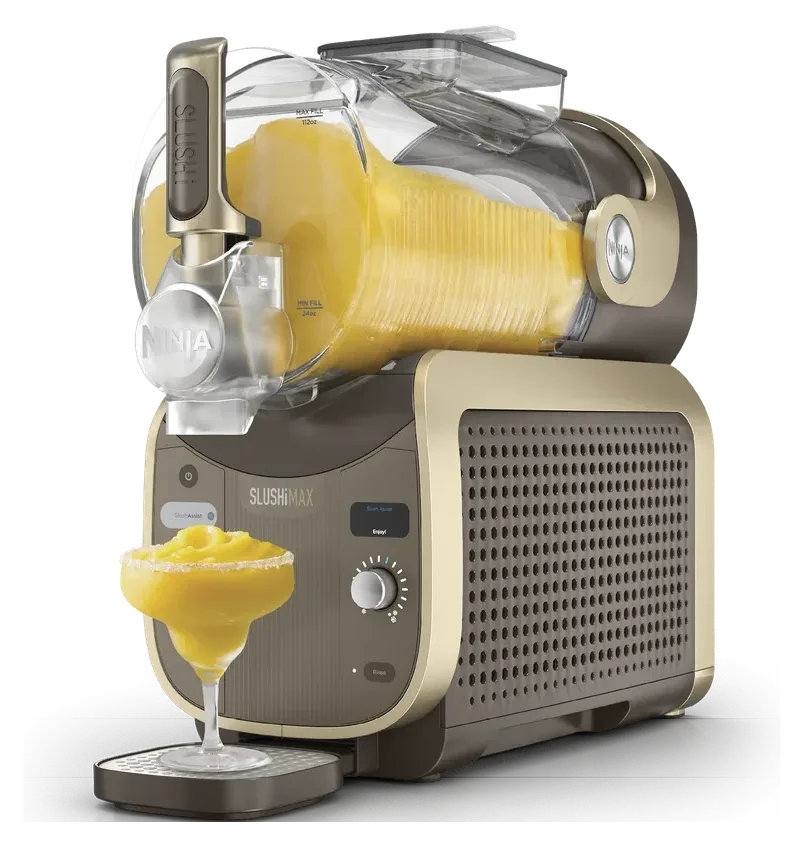
Ninja's machines sense when something is wrong. The FS301 shows a low-sugar alert if the input has too little sugar and a high-alcohol/high-sugar alert if it has too much. The newer SLUSHi Max goes further: its SlushAssist program spends 10 to 15 minutes "sensing" the ingredients before it sets its own temperature (FS605 guide).
Why does it take 15 to 60 minutes?
Ninja says drinks take 15 to 60 minutes "depending on ingredients, volume, and starting temperature." VEVOR's X-40 listing gives 20 to 65 minutes depending on the room temperature (VEVOR X-40 listing (paid link)). The range comes from physics:
- Freezing takes far more energy than chilling. Turning a gram of water into ice at 0 C means removing about 334 joules (Wikipedia, Enthalpy of fusion), roughly 80 times the energy needed to cool that gram by 1 C. A home compressor of about 200 watts (the FS301 is rated 200 W) can only move heat so fast.
- Volume. 64 oz holds four times the heat of 16 oz.
- Starting temperature. A drink from the fridge skips the cooling step. Ninja recommends chilling liquids first.
- Ingredients. More sugar or alcohol means a lower freezing point, so the drum has to pull the mix colder before it thickens.
- Room temperature. The condenser sheds heat less efficiently in a hot room.
When the slush reaches the set temperature, the FS301's LEDs go solid and it beeps, then it keeps running to hold that texture. Ninja says the unit can run for up to 12 hours. If it is still thin after 60 minutes, the guide says to raise the temperature level one step and check after 10 to 15 minutes. The Ninja SLUSHi usage guide covers this in detail.
How do home and commercial slushie machines differ?
| Feature | Home compressor machine | Commercial granita (bowl) machine | Frozen carbonated (ICEE-type) machine |
|---|---|---|---|
| Example | Ninja SLUSHi FS301 | VEVOR two-tank commercial unit | Shop fountain machines |
| Capacity | 16 to 64 oz (FS301) | 2 x 12 L tanks (XRJ12X2) | Commercial scale |
| Bowls | One vessel | Two or more bowls, each with its own auger | Sealed freezing cylinders |
| Pressurized | No | No | Yes |
| Carbonation | Soda mostly loses its fizz | Not designed for it | Carbon dioxide is held in the mix |
| Temperature control | Programs and levels | Adjustable, 5 to 59 F on the XRJ12X2 (listing) | Commercial controls |
Commercial granita machines are the bowl machines seen on shop counters: clear tanks with augers turning inside, each tank its own flavor. They work exactly like the home version, just larger and built to run all day. Frozen carbonated machines are different again: Wikipedia describes the mix being held under pressure in a cylinder surrounded by freezer coils, which keeps the carbonation in until it is dispensed (Wikipedia, Slush). For how Slurpee and ICEE fit in, see what is a slushie.
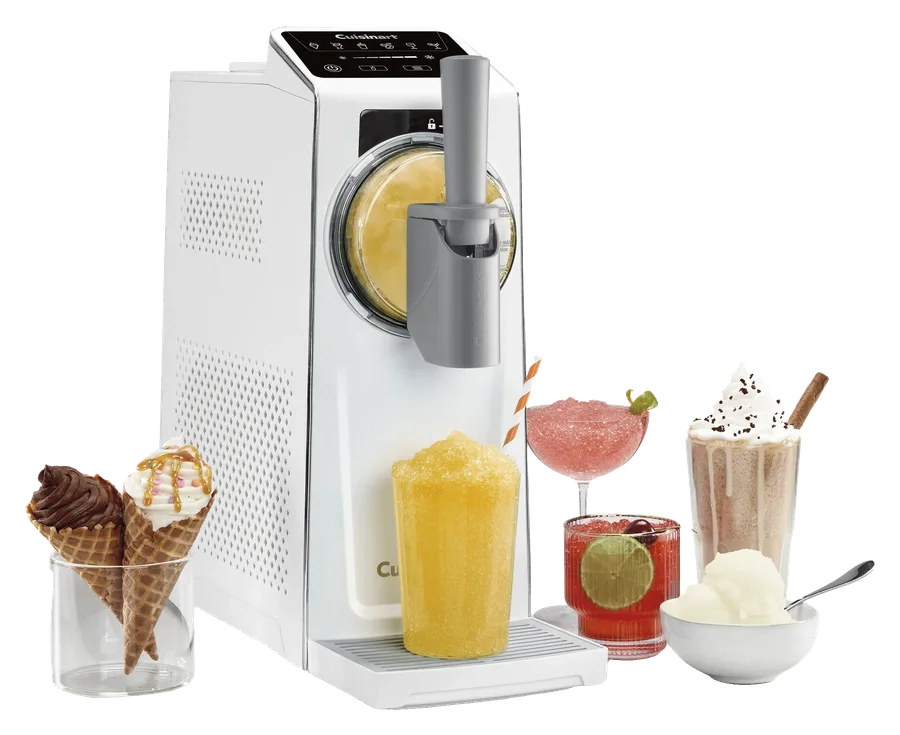
Some compressor machines use a bowl and paddle instead of a drum and auger, and make soft serve as well as slush. The Cuisinart 6-in-1 Slushy and Soft-Serve Maker is one; its maker says it needs no pre-freezing.
How do machines without a compressor work?
Ice and salt canister machines
Machines such as the Nostalgia 32 oz frozen drink maker freeze the drink in a canister surrounded by crushed ice and salt, while a dasher stirs it. Its listing says drinks must be sugar based (Nostalgia NSM32 listing (paid link)). Salt water on ice gets far colder than ice alone, about -22 C (-8 F) for salt, water and ice (Wikipedia, Frigorific mixture), which is what freezes the drink. It is the old hand-crank ice cream maker idea with a motor.
Ice-shaving frozen drink makers
These do not freeze anything. A blade shaves ice cubes from a reservoir and a paddle or blender blade mixes the shavings with the drink. The Margaritaville Bahamas with No-Brainer Mixer shaves and then blends; the Elite Gourmet frozen drink maker shaves while a paddle stirs. Because the cold comes from ice, they work with any drink, sugar or not, but the ice dilutes it. Snow cone machines use the same shaving idea without the mixing.
Squeeze cups
A squeeze cup has a double wall filled with a freezing liquid. You freeze the empty cup, pour in a cold drink, and squeeze. Ice forms on the frozen inner wall and squeezing breaks it free. The Color Land Slushy Cup listing says it takes about 2 minutes of squeezing (Color Land listing (paid link)).
How do the types compare?
| Type | Cold source | Ice breaker | Needs sugar | Time to slush | Dilutes the drink |
|---|---|---|---|---|---|
| Home compressor | Refrigerated evaporator | Auger | Yes | 15 to 60 min (Ninja) | No |
| Commercial granita | Refrigerated cylinders | Auger per bowl | Yes | Varies by load | No |
| Frozen carbonated | Refrigerated, pressurized cylinder | Dasher | Yes | Continuous | No |
| Ice and salt canister | Ice and salt brine | Dasher | Yes | About 15 min (Mr Slushee listing) | No |
| Ice shaver and mixer | Ice cubes | Blade and paddle | No | A few minutes | Yes |
| Squeeze cup | Pre-frozen cup wall | Hand squeezing | Yes for soft slush | About 2 min | No |
To browse every type, start at slushie machines, or use the machine finder to narrow by size and freezing method.
Quick answers
Does a slushie machine use ice?
Compressor machines do not; they freeze the drink directly against a refrigerated cylinder, and Ninja's guide forbids adding ice. Ice-shaving frozen drink makers and ice-and-salt machines do use ice.
What is the spinning part in a slushie machine?
The auger (also called a dasher). It scrapes ice crystals off the cold cylinder and keeps the drink moving.
Why does a slushie machine take so long?
Freezing water removes much more heat than chilling it, and a small home compressor moves heat slowly. Volume, starting temperature, sugar and room temperature set the time.
Is a Slurpee machine the same as a home slushie machine?
No. Slurpee and ICEE machines hold carbonated drinks under pressure. Home machines are open, non-pressurized and make still slush.
Why does the machine get warm on the sides?
That is the condenser releasing the heat removed from the drink. Ninja says to keep 4 inches of clearance on the sides and back.